Visionaries should crunch numbers.

Quiet Babylon


Privacy Is Not the Opposite of Freedom

Wednesday June 9, 2010 by Tim Maly

On June 5, Newsweek’s Julia Baird published an op-ed entitled The Front Line Is Online. In her subhead, she declares that “freedom should trump privacy.”

She spends some time reliving Neda Soltan’s death and some time talking about the growing consensus that access to the Internet should be a fundamental right. What follows is some depressingly muddy thinking about how to proceed.
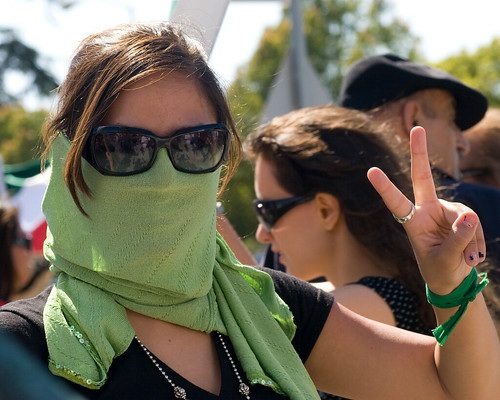
IMG_7776
Creative Commons License photo credit: killerturnip

One in seven of those who do not use the Internet think they should have the right to if they want. Yet only half of those surveyed felt the Internet was a safe place to express their opinions, and more than half thought that it should never be regulated by the government. Which may suggest that some people are willing to accept some compromises to privacy to avoid the creeping censorship that too easily follows government intervention. The basic tenet of the Internet is openness: you don’t need to forfeit all privacy, but if you want to protect it, don’t post publicly.

The debate about quitting Facebook certainly takes on a different hue when exposure, not secrecy, becomes the critical fight. In the past few weeks, both Pakistan and Bangladesh shut down Facebook in response to the group Everybody Draw Mohammed Day, because it is considered blasphemous to create images of the prophet. Facebook has been slammed by clerics in Egypt and Syria for being a gateway to adultery; and a woman was shot in Saudi Arabia after her father discovered her chatting online with a man she met on the site.

Increasingly, the idea that everyone should be able to log on, publish, upload, download, update, or tweet at will—and whim—seems vital.

Julia Baird – Newsweek The Front Line Is Online (emphasis added)

Baird sets up a false opposition between freedom and privacy, and then undermines the argument with her own evidence. The key insight missing is that privacy isn’t in conflict with freedom, it’s a component of it.

Most liberal democracies have a whole pile of rights that recognize this. It’s the freedom from unreasonable search and seizure. It’s why the government can’t read our mail in most free countries. It’s why we get so upset when we learn that we’re getting wire-tapped.

When “if you want to protect it, don’t post publicly” holds sway, the woman in Baird’s last example has two choices: get shot for chatting with men or don’t talk to men at all. That’s not freedom. The thing that could have freed her from her father’s insane grip is secrecy; she lives and is free only insofar as she is able to keep her private life away from his murderous attention.

When social networks make it hard to keep your doings private, you put yourself at greater risk of discovery. We should have learned this lesson when Google Buzz exposed a woman to her abusive-ex. We should have learned this lesson when Evgeny Morozov pointed out that “once regimes used torture to get this kind of data; now it’s freely available on Facebook.” We should have learned this lesson when US activists used Twitter to wiretap themselves and megaphone it to the police.

A world where you can’t keep your list of friends hidden is a world where governments can figure out networks of dissidents. psychotic family members can find out you are talking to the wrong people, and the police know which door to kick in. Removing censorship makes posting easier – it doesn’t make it safer. Shielding from prying eyes does. That only happens with good, reliable privacy controls.

To have real freedom, we need both.


  • "The key insight missing is that privacy isn’t in conflict with freedom, it’s a component of it."

    Very well put; I think a lot of people forget about this.

    Tami has a good strategy in simply confusing trackers with multiple personalities and anonymity programs, but there are other strategies. There's no reason for "multiple personalities" to talk to each other. There's not even a reason to have a personality online at all.

    I use Facebook, sure, because I don't want to lose touch with people who only use it, and don't answer their email. But my Facebook profile is tight--I have all of the privacy controls on the most private settings.

    Aside from Facebook, I have a business personality online--one I blog with and produce with. But this is fine, since these media are completely controlled by me, and my association with them is preferred.

    Another, and preferable state of mind is to adopt no secrets and have no shame--this removes the risk of exploitation entirely.
  • Mikael Cham
    I love how the freedom fetish falls down as soon as we acknowledge that sometimes people need protecting from otehrs' meanness.
  • Mikael Cham
    I love how the freedom fetish falls down as soon as we acknowledge that sometimes people need protecting from otehrs' meanness.
  • Keeping private on the internet involves having multiple personas across many sites, all with different names. To keep the authenticity up, you need to be able to carry on conversations between personas, without ever making it look like they are all same person. In addition to this, it's good to have intimate knowledge of Tor, as well as adressing conventions from other countries, and falsifying addresses and such where you can.
    The only site with accurate information about me is Paypal, and that's purely out of necessity. I use four different usernames, which I occasionally drop at random. I try to keep each one seperate from the other.
  • Is freedom the ability to keep secrets, or the ability to not need them? Or put another way, is freedom the ability to rebel against control, or to not be controlled?

    Obviously it is too complicated of a question to pick a microcosmic metaphor to represent the entire duality. But let me put it in these two ways.

    1) You go live on a compound in the woods, free to run naked, take drugs, and avoid any oversight by the State. Until the day other woods-living bandits surprise you and kill you.

    2) You conduct guerrilla warfare against the oppressive State, sniping guards at the local Moral Re-education Prision. Until the day the State develops a magnet-ray, rendering your rifle useless. You join a public protest against magnet-ray usage by the government, claiming it is State intrusion into the private electromagnetic sphere. Seperation of Current and State, etc.

    Example 1 is the false Hobbesian duality metaphor that most people choose to represent "freedom". War of all against all, or social contract. Either get with the program, or live in anarchy, buddy. You must pick one.

    Example 2 is more of the real situation: a multiplicitous Foucauldian panopticon model, if I had to give it a name. The "social contract" we live with is a constant battle for power among an unlimited number of parties and pathways, whether with weapons, words, or technology. Every tool has a use and a weakness. You get a world-wide messaging service, you get a world-wide info sniffing portal. As technology advances, the old dualities between People and State, Control and Anarchy, bend and shift as certain sides gain ground, and implement different moral tactics to try and gain the upper hand, or prevent the other side from gaining the upper hand. You say 'non-proliferation', they say 'missile gap'. You say 'freedom of speech', they say 'child porn'. You say 'privacy', they say 'safety'. But in the end, everyone is still struggling to control the everyone else. It's not about find the safe position from which you can snipe anyone with impunity, its about doing what you can with what you can. If half of people are open to government censoring of the internet, it is because they think this outcome benefits them, regardless of whether we can call it "freedom" or not. It's like how some americans think owning guns means freedom, and some americans think gun control means freedom.

    It seems to me that rather than starting with "freedom" and working backward to what actions define it, we need to ask what action we are deploying the idea of "freedom" to defend? Are we demanding that the government leaves us free to be dissidents as an "inalienable right"? Or are we signing up to be dissidents because we feel the control of the government does not benefit us in a tangible way, and in order to be dissidents, we need to be secretive?

    Regardless of the intellectual debate, I think it will remain that those "with something to hide" will go on trying to hide it however they can, and those "with something to discover" will keep trying to find it.
blog comments powered by Disqus