Lanyards & Pockets
I'd like to talk about augmented reality. Specifically, I'd like to talk about augmented reality, the things you carry in your pockets, and the things you wear around your neck.
Primer
AR basics: It's an extension of the mobile Internet (that's the one where people are walking around with computers disguised as phones in their pockets). The mobile Internet is what happens when devices become untethered from power, ethernet, and phone cords. As the early engi-pioneers in flooding the physical world with metadata try to sort out how it'll all work, I've noticed a curious process by which these devices are evolving into two distinct branches.Let's call branch 1: Things You Keep In Your Pocket. These are the iPhones, Blackberries, Androids and other smartphone-type things. The apps are stuff like Layar and Nearest Tube. Implicitly, I've been acting as if these are the only devices. Not so.When I started writing this, it was a joke post. The title was Lanyards: Official accessory to your augmented reality and I was going to open with with this quip from Bruce Sterling:
 photo credit: tranchisLet's talk about finding a restaurant.
Techno-Evolution
I wish designers would stop imagining that customers really really want to carry imaginary geek-junk around their necks on lanyards. We all know that 99.995% of designers would rather be killed than wear a dorky lanyard, so why inflict that on the rest of us?
Bruce Sterling Beyond the BeyondThe joke would have been a string of photos from promotional material of people looking fabulous with near future tech toys hanging from their necks. Stuff like this: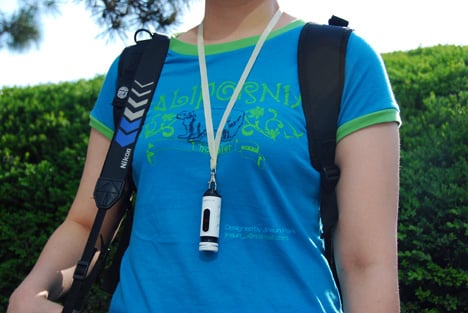 Maptor by Jin-Sun Park and Seon-keun Park, featured on Yanko DesignSo branch 2 is: Things You Wear Around Your Neck, AKA Technology on Lanyards. I'm fascinated by this branch.(There is also a branch 3: Things You Wear On Your Head, but it's gone dormant for some reason. It's possible that through convergent evolution, branch 2 will come to look very much like what branch 3 might have been. Branch 4 is, I suppose, Things Embedded In Other Things. This'll be when your car's windshield has data displays glowing at you. Imagine a fighter jet's HUD and you get the idea. The hold an image up to a webcam apps fall into this as well.)


Pockets
Right now, branch 1 apps are the most successful. They spread parasitically by running on top of devices that are already popular. There's a lot of gee-whizery here. They make your boring old phone/computer/thing act like magic. It's something you can pull out and show your friends. They are socially acceptable, because everyone you know already has a mobile phone.They are also, for the most part, party tricks.Take a look at the Nearest Tube demo again. Leaving aside the jittery icons, imagine yourself trying to use that thing to get around. It has arrows pointing you to the nearest stations but those arrows point as-the-crow-flies. You are in a city - in particular, you are in London. If there is one thing I can tell you about the route from your current location to the nearest tube station, it's that it's not a straight line.
View Larger MapYou are left holding your phone in front of you, constantly adjusting for the turns in the road. Sometimes you have to point the thing up into the sky, depending on where the icon stacking has seen fit to put your particular destination. Compare that to the (suddenly) old-fashioned Maps technique of showing you a birds-eye view of the surrounding area and a turn-by-turn suggested route.
Lanyards
The lanyard devices are quite different from the pocket ones. They are not even a little socially acceptable. No one looks good in a lanyard and if you are the kind of person who moves around much, they are get in the way all the time. They're uncomfortable. They chafe the neck and if the thing on the end is at all heavy, they cause soreness. They evoke high school coaches with stopwatches and perky tour guides with clipboards.They also imply a very different mode of interaction than the pocket devices.Pocket augmented reality tends to being active, burst-use, and private. It uses tiny screens on a personal device. No one else is meant to see what it shows beyond the person holding it. You have to actively decide to take it out and make use of it, and it spends most of its time in sleep mode in your pocket.In contrast, lanyard augmented reality is passive, always-on, and public. These are fuzzy boundaries, but take a look at a few prototypes and you'll see what I mean.I've already pointed to Maptor, a GPS device that projects a map of your immediate surroundings onto a nearby surface. Yanko's pitch for it talks about how useful it is because no one need ever know you are lost. They gets this exactly backwards.Lost and don't want anyone to know? Projecting a glowing map will probably blow your cover. You are much better off pulling out your Droid and pretending you are looking at text messages while you find your way.On the other hand, being able to unfurl a map where everyone in the group can see? That's something missing from tiny screens. With Maptor, a group of people can gather around and point to the things they want to talk about, taking navigation back to the shared collaborative experience that it was when we had paper maps. The Vicon Revue. Image from Reportages PhotosThe Vicon Revue is a fish-eyed camera that hangs around your neck and takes photos every 30 seconds. This is perfect for reconstructing whatever happened after tequila number 5 or for self-incrimination at trial.It's also perfect for illustrating the passive part of lanyard augmented reality. With a pocket device, you need to pull it out of storage to start using it. You need to decide in advance that there's something you want to capture. The Vicon reverses that. It's always recording. Your decision is when to turn it off and, when you get home, what to edit out.
 MIT's Sixth Sense. Image from Dustin Kirk's blogSixth Sense combines the camera and projector into a kind of mega-lanyard hybrid. Watch the demo here and see if you can feel the difference between that and a pocket device.In its current state it's clunky and socially clueless (the best moment is when it projects metadata onto the hapless acquaintance). It's the kind of thing that only experimental engineers and conference-goers could love. But it's also a fundamentally different attitude about the world and how the digital should bleed into it.It's always running, always scanning, always recording, and always waiting for instructions. Even picture-taking is changed. The act of framing the image you want isn't taking a picture, not really. It's telling the device which pictures to keep.The projector is also very different from the private screen for all the reasons that Maptor is different from Maps on your phone. Other people can interact with the data. When he looks at the toilet paper and his rig tells him it's OK, his roommate can be standing next to him and seeing the same conclusion. The digital isn't being edited onto a video of the world, it's being literally projected into it.The name of the application speaks to the ambitions of the project. They want something that is so wholly integrated into your life that it feels like part of you.It's early days here in the augmented reality field and if the early developers keep making dorky devices, let's cut them a little slack. After all, the Apple ][ became the Mac.