Speculative non-fiction.

Quiet Babylon


How Deep Do Cities Go?
Monday August 3, 2009 by Tim Maly

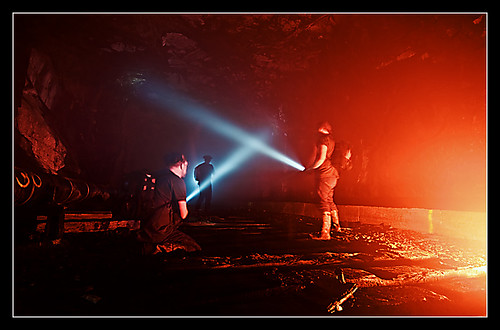
Tunnel_Trio
Creative Commons License photo credit: Pro-Zak

Here’s a Pair of Questions

  1. How deep do cities run on average?
  2. What is the deepest city?

A few days ago, I asked these on Twitter and after a bunch of smart-aleck replies, got two candidates for deepest city infrastructure.

Did you get an city depth answer? There’s a qanat in Iran that’s 1,200ft deep.

@HeatherMcGaw

3500m deep gold mine within city limits of Johannesburg. Has a pub (pub only 226m deep). http://trunc.it/14i2a

@sam_mack

Although Sam’s answer is deeper, I’m unsure about whether it gets counted on the technicality of the mine happening to be inside city limits, where Heather’s is a piece of infrastructure necessary to day-to-day operation of the city (qanats are really neat, by the way).

No one had an answer for how deep cities tend to be on average.

The Depth of Cities

It’s easy to forget about the depth of cities. For the most part, buildings look like they are perched on the surface. Sure, in the back of your mind you know that there’s a foundation and a sewer system, but that’s not really felt.

Then you’ll turn a corner and see a pit where they are laying the foundation for a new skyscraper, or you’ll glance into a grate as you walk along the sidewalk. Maybe you’ll step onto an escalator in a subway station, or late one night, wandering with friends, you’ll explore an underground parking lot. And it will go down, down, down. You’ll experience vertigo at ground-level.

You’ll think about Paris’ catacombs and New York’s lost subways. You’ll think about Tokyo’s storm water system and Seattle’s buried streets.

Every city has a sprawling network of sewers, caves, tunnels, foundations, subways, walkways, and lost infrastructure. How many layers? How deep do they go?

Any ideas?


  • scott
    I was walking through an old parking lot the other day, one that nobody uses, and I saw a hole in the ground about three feet deep, covered by two large concrete slabs, put there as if to prevent people from falling in. After looking into the hole, I noticed the side branched off into a much larger area. I mentioned this to my friend offhandedly, and we went in to explore.

    Turns out the parking lot was actually the ground level of a building that stood there a while ago. The hole led down into a room, where the doors and stairwells had been collapsed inward intentionally to prevent people from exploring.
  • This is an important illustration of why everyone should carry a small flashlight at all times! That sounds like a really cool environment. How big was that area that you were able to explore? Just the one room?
  • I don't live in Paris, but I have heard there are 4 levels that are known of...nobody has really been able to say just how far or deep they go, or map the tunnels out exactly. It has been attempted, with sonar, but I don't think that a complete map was ever made. Given the size of the area, and the difficulty of finding people lost down there, I can see why most of the entrances to the tunnels have been sealed.

    There are caves under Sydney Harbour as well. Access to most is blocked, but they do exist, and they are apparently quite fun to explore. There's a few cave networks in Australia, but most of the ones I know of aren't under any cities and have been fairly well-explored.

    And think of what the London Underground will look like in a few centuries (if it is ever abandoned). I would love to explore it then.
  • If I ever get to Paris, I will be desperately trying to take a tour of the catacombs.

    Add to your list:
    Moscow's possibly mythical Metro-2.
    Seattle's definitely real underground streets.
  • gypsy
    neverwhere, anyone?
  • chebucto
    IAMAHE , but reading the WIki article it looks like Qanats feed water via gravity. So, measured by sea-level, they are above the city.

    The St. Petersburg subway system is one of the deepest in the world; wikipedia puts its deepest station at 105m below surface, though apparently the Pyongyang system in North Korea has track that is 110m deep.

    Perhaps the most impressive deep city infrastructure is the new New York water tunnel (http://tinyurl.com/mocryn) - up to 240m underground with a 7m diameter. Construction began in the 1970s, and will finish in the 2020s. Yikes!
  • Just about all the underground infrastructure will be below sea-level, no? The few places where it isn't means constant pumping. So I'm not sure if that disqualifies the qanats.
  • chebucto
    Sea-level is a simply reference altitude; measured by this, Qanats are above cities, because water flows downhill. Think of water tanks in small towns - the tanks must be above the altitude of the highest house they serve, or water will not flow from the tank to the house. Qanats rely on gravity, too, so they must be above the cities they serve (using nearby hills or long tunnels to ensure the necessary delta-altitude.)

    NB, too, that city infrastructure is not necessarily below sea-level; this is especially true for inland cities. Think of Denver, or Kathmandu - they are 1000s of m above sea-level, just like their infrastructure.

    =====

    Hmm.. just read your post again and I see the confusion: Qanats do not need to be below sea-level.

    First, note that the groundwater level is not related to sea-level. Ground water flows like surface water. The average depth of a water table is dictated by local geology. A bed of clay is basically impermeable, forcing the water table to say above it, while a bed of gravel is permeable, allowing water to pass through it to greater depths.

    Now, consider a normal well: it reaches the water when it reaches the water table. Water is then forced, by pump or bucket, to come out of the top of the well. The depth of wells varies from place to place, depending on local geology and precipitation patterns.

    Qanats, as I understand them, are artificial void spaces (wells) created in aquifers, with a tap at the _bottom_, from which what is essentially an aqueduct slopes downhill towards the city it serves. This image (http://tinyurl.com/klv2gj) clarifies.

    So, by surface level, Qanats are very deep; by sea level, they are above cities.
  • Sam
    The gold mine doesn't just happen to be in the city limits. Johannesburg was a gold town built around the mine. Before the gold there was only a small village, and that mine is what made Johannesburg one of the largest city in Africa.
  • I stand corrected! Johannesburg is originally a mining town, so maybe it does get to count.

    Do you know if the mine is used for anything at all these days?
  • chebucto
    Do you know if the mine is used for anything at all these days?

    I heard they're re-opening parts of it; the recent high gold prices have made it economic again. What's neat about the new works is that they're putting a significant part of the processing plant underground, too, within the mine (the surface above the mine being taken up by city).
  • Sam
    Probably nothing. Old mines are not usually that useful.

    I also have a comment about the average depth. Think of a city like a tree, the size of the roots are directly related to the size of the tree. The same is true for cities, taller cities need deeper foundations. Tall buildings need deep foundations to support there weight, but also taller buildings mean more people in the same place, requiring larger water and sewer pipes, more underground parking, maybe subways or underground walkways, larger underground conduits for electrical infrastructure and the like. The actual depth is hard to say, but if I had to take a (slightly educated) guess I would say 1/10th the average height of the buildings (with some anomalies under very tall buildings).
blog comments powered by Disqus