Creative destruction.

Quiet Babylon

Conference Badges: Early Augmented Reality

Thursday December 3, 2009 || by Tim Maly

When I was working on the idea of the pocket-device model of augmented reality versus the lanyard model, I realized something about conference badges that didn’t really fit into the piece.

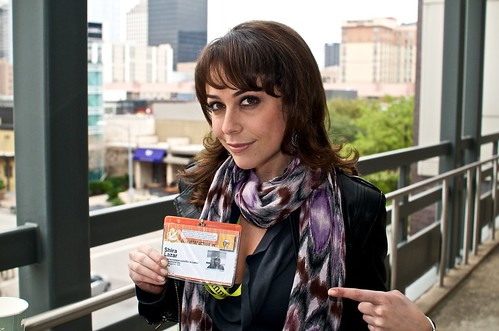
Shira Lazar
Creative Commons License photo credit: jdlasica

Conference badges are little ancient proto-augments.

They are a way for people to carry around and display metadata about themselves. The basic bit of data is “I am allowed to be here”. Most conference passes add to that details such as who you are and who you work for. Some conference badges add in slots for customization such as press-clippings, your business card or whatever else you feel like tossing in there.

Everywhere you go, there’s the badge, broadcasting who you are and whether you are authorized. Anyone around can take a look and grab your data (such as it is). They are – as in all the lanyard augments – public, passive, and always-on.


Filed under: design, futurity ||
  • As I mentioned to you on Twitter, museum audio guides are an early kind of augmented reality. I mentioned this in an Icon review about two years ago: http://tinyurl.com/ydhgspu

    Looking back, it's curious that I call it "augmented space" rather than "augmented reality", even though the latter term appeared in the book - writing for an audience of architects, I think I preferred to present it as an enhancement to environment rather than to experience, which now seems backwards.

    I once walked around an exhibition hall filled with student design wearing a badge saying "judge" - Icon was giving an award that year. It was a rather strange experience, because obviously I was treated incredibly nicely by everyone. It was like being the usual me, only in some weird solipsistic wish-fulfilment fantasy in which I was the charisma king. It was a little creepy, to be frank.
  • Will, have you heard about the Murmur project in Toronto? There are these green signs all over the place with a phone number and then you call in and get to listen to an oral history or story about the area where you are standing.

    I actually think I like augmented space over augmented reality. Especially for this crop of apps. Maybe when we all have Google Goggles, that'll change and it'll feel like reality is being augmented (or spammed).
  • ((Some of my friends sent me comments about this which I'm reproducing here, because they were really interesting))

    emily horne of A Softer World
    and of course, cons like DefCon take the personalizeable/reactive badge to a whole other level. often of course, given the people who are modifying these badges are doing so in order to obscure their identities rather than broadcast them (i'm thinking particularly of the guy who fixed his to defeat facial-recognition software).


    Tess Girard, Filmmaker
    I notice this at the Toronto Film Festival when you have a pass, people peek at it to see if you're an important celebrity.

    At Berlinale they had a barcode for their talent campus. For every seminar, you were scanned. Since it was an all expense paid conference they could tell if you attended the seminars or if you just used the trip as a free pass to Berlin. Then, when you applied the next year they looked at your scanned data. If you went to many seminars - bing - you were reaccepted.
  • Jennifer
    Also, people use them as a human bar code. You can scan them to see who has entered the trade show or even who has stopped by your booth.
  • So dogtags would similarly be "corpse-destination augments".
  • Yes!

    Meta-data everywhere!
blog comments powered by Disqus