The future needs to be back-ported.

Quiet Babylon


On a Grand Scale – Buildings That Protest 3

Monday August 24, 2009 by Tim Maly

Part of a series: Buildings That Protest

Recap: We’re talking about Alain de Botton’s comment that buildings are forced to sit in silent protest as the people under their care take actions and enter into moods that violate the spirit that the architect was trying to infuse. While this is historically true, we are changing that relationship. Smart buildings will be able to talk back.
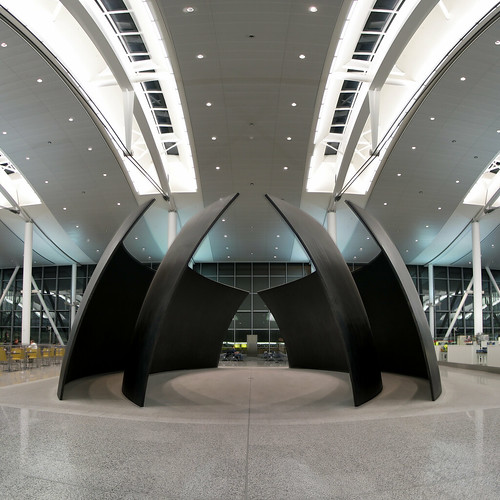
Tilted Spheres
Creative Commons License photo credit: Ian Muttoo

So far, I’ve focused on houses as places where this kind of interactive architecture might take hold. There is no reason to think that it might stop there. If anything, we’d expect large structures – designed to move masses of people instead of individuals – to be the early experimenters in crowd control.

Scenarios

After the planes hit the towers, all kinds of security mechanisms were proposed for airports. Applying facial-recognition to the already ubiquitous CCTVs was a popular idea until it turned out that the tech was not ready. Someday it will be. Forget cumbersome security lines, why not equip the entire building with highly sensitive chemical noses? A network of sensors can cross-reference the movements of travellers, looking for suspicious patterns. A system of bulkheads isolates potential threats until human security can arrive and confirm the arrest.

The airport knows how long you’ve been waiting and by how much your flight is delayed. The building can alter lighting, music and even air content to soothe worried travellers. Nothing dangerous, mind you. Simply a mild sedative to keep everyone orderly. Raising your voice at the check-in clerks? Well, why shouldn’t the building intervene?

Anything that seems like a good idea in an airport will seem fantastic in America’s overburdened, understaffed prisons. Jeremy Bentham’s panopticon suggests a direction. So do South Africa’s armed ATMs. Why put human guards at risk in dealing with unruly inmates?

Schools aren’t precisely the same as prisons, but many of the same discipline issues arise. Hall monitors can’t be everywhere, but the hallway can. Truancy promises to become a thing of the past, there will be no opportunities to loiter in the stairwells. Rumours spread through the student body of a network of tunnels and maintenance rooms behind the walls, unmonitored. Everyone knows a friend of a friend who’s been there. Pranksters are expelled when they hack the fire suppressors one time too many.

In kindergarten, the rooms gently ease the class in and out of nap time. At certain private schools, anxious parents demand detailed positional reports for the teachers of their child. They pour over the data, looking for signs of favouritism, hints that they aren’t getting their money’s worth.

Churches? We are all god’s children, and a place of worship should use every technique available to the maker to help bring the flock to the right state of mind.

Casinos, malls, amusement parks, boulevards, freeways, undergrounds. There is no place in the world that would not be changed by an infrastructure that could talk back. The flavour of conversation will reflect the spirit of the times and the ambitions of the builder.

What will ours say?

All of: Buildings That Protest


  • I am in love with your brain.

    These posts are my favorite kind of futurist thinking, not "gee-golly we'll have flying cars" but "man, flying cars would cause so many traffic engineering headaches." Do you by chance write science fiction? You have that gift, I think, of looking at a trend and fearlessly extrapolating all the way down the line what it would mean, and then standing at the end of that line and asking, "and what would that mean to people?"

    I think, rather than asking, "What will ours say?", we should be considering "What should ours say?" All your scenarios here gave me little dread-tinglies down my spine. I don't want this future. But it's extremely plausible, of course, it's almost certainly coming and I don't see a way to stop it. If these technologies grow riotously, with no thoughtful regulation or control, they will smother us. But if we start thinking in terms of "should" and "ought", maybe we could prune these ideas like bonsai into shapes more pleasing to us. Maybe politicians and teachers and police want to soothe and control "the masses" - but I bet they themselves don't want to be soothed and controlled.

    Digression: I remember reading about libertarianism one time, and the "shortest political quiz". One of the possible outcomes on the quiz is "Statist", which essentially indicates you think personal liberty is impractical or unwise, that people simply can't be allowed to choose for themselves because they will never choose the "greater good". But the longer explanation used to say that many people who favor Statism are caretakers like police, nurses, and teachers, who spend their lives helping and making decisions for people who really can't take care of themselves.

    Well, what is, is... and by extension, what must be, will be. Always better to go in with your eyes open. Have you read anything at Design with Intent? It seems relevant to your interests.


  • There are privacy issues abounds in 'public buildings that protest'.

    I think that the majority people will ultimately consent to such interactive infrastructure, but also that a small minority will refuse it.

    Most will consent to their personal data being mined in public spaces, used by government organizations and private corporations under the guise that it is necessary to improve the life of the individual.

    And it will improve our lives in measurable (and immeasurable) ways, we wouldn't put up with it otherwise.

    Like the internet, anything you do in a public space will instantly become a matter of public record. It will take some adjusting to, but people, especially those of us who grew up alongside the internet, will adapt to the new technologies relatively quickly. Soon, we will be adept at discerning when were are in a private 'secure' setting and when we are in a public 'unsecure' setting.

    Those who don't want to be open to such interactions will lose out on all of the benefits that a two way relationship with the built environment offers. It will be a choice, though, even if it means illegally blocking yourself from the infrastructure 'sensors', or establishing interactive-architecture-free zones, or escaping from urban areas entirely.

    Really: If you do something in a public space it is recordable.

    Already, Today.

    Even if it is in the subconscious memory of a passerby, even if it is only recognizable by a Sherlockian expert, if it is perceivable and public then it is open to collection, analysis and scrutiny. If forensics shows have taught me anything it is that we already leave a record of ourselves and our actions in the realm of the real.

    It's only a matter of time before we develop software and hardware capable of collecting this information, and once incorporated into our public architecture these (probably highly regulated) technologies will enable our buildings to protect us, serve us, guide us and nurture us.

    Lets just hope these powerful technologies aren't severely abused (they will be).

    Disclaimer: I am not a person of strong conviction. I rarely pick one side because it is what I firmly believe, really, I see the merits in all sides of a rational argument. I'm merely here to converse, not to debate to the bitter death...
  • It's an enormous and possibly intractable problem. I'm reminded of the Unabomber's complaint that even in his shack, as far from humans as he could get, there were contrails of jetliners visible in the sky. The technical regimes tend to be very encompassing and difficult (or impossible) to reject or avoid.

    One of the big things that we face in the new world of privacy is that stuff that has always been theoretically possible but very very hard (as you say, we have always been subject to recoding in public, but if someone wanted to follow me, they had to invest significant time and labour) has become routine, mechanized and post-industrially ubiquitous.

    The EFF's brief on locational privacy offers a really good primer on why we ought to be wary, if not outright terrified.
  • Disclaimers Disclaimer: The disclaimer isn't directed at you, sir.

    Really, this is only necessary if someone stubborn and annoying stumbles this way and thinks I am game for a battle of wits.

    I'm not.

    I just like discussing architecture and futurism.

    And I really enjoy your blog!
blog comments powered by Disqus